Welcome to the public exhibition on the proposals for Land north of Dry Street.
RO Land is bringing forward proposals for the future of Land north of Dry Street, in partnership with Home Group.
The plans will bring forward up to 61 new homes, aimed at key workers, all within 500 metres of Basildon University Hospital, that will help address Basildon’s housing need.
The proposals also feature an ambitious landscaping strategy, with attractive green routes woven through and around the site to enhance air quality, boost biodiversity, and promote sustainable travel and recreational activities.
Aerial view of the Land north of Dry Street

Aerial view of the Land north of Dry Street
Share your views
We are keen to understand the views of our neighbours and the local community ahead of finalising and submitting a planning application to Basildon Council.
If you have any further questions or know of someone unable to attend today’s session, they can provide their feedback to the project team directly.
Contact details:
Email: landatdrystreet@kandaconsulting.co.uk
Tel: 020 3900 3676
FAO: Land at Dry Street Consultation Team
Kanda Consulting
10 Chiswell Street
London, EC1Y 4UQ
Project Team
We thought you may be interested to learn more about the project team bringing forward proposals for Land north of Dry Street.
RO Land
The Applicant

RO Land is a business that invests in residential and commercial land in southern and eastern England. It is part of the family-owned RO Group and has an impressive track record in property development.
Intermodal Transportation
Transport Consultant

For over 25 years, Intermodal Transportation has delivered comprehensive transport solutions for property developers, townplanners, and local authorities, including highways, transport, and drainage projects tailored to diverse client needs.
Carter Jonas
Masterplanners

Carter Jonas provides masterplanning and urban design solutions for residential projects of all scales. Their team’s approach to creating a good place to live involves the comprehensive assessment of the constraints and opportunities of a site, before the iterative process of testing different design options.
Turley
Independent Advisors in Planning and Development

Turley provide expert advice to shape sustainable places, guide planning strategy, and support the delivery of projects that benefit communities.
Bidwells
Planning Consultant

Bidwells provides expert planning advice across residential,
commercial, and mixed-use developments. Their team guides projects through the planning process, helping to secure approvals and deliver sustainable, well-designed outcomes that respond to local needs and policy requirements.
Arc Arboricultural Solutions
Arboricultural consultants

Arc Arboricultural Solutions provides expert tree and woodland
management services, supporting developments and local
authorities with sustainable and compliant landscape solutions.
Applied Ecology
Ecology consultants

Applied Ecology delivers expert ecological advice, helping developments balance growth with environmental protection and biodiversity enhancement.
Kanda Consulting
Engagement consultants

Kanda specialises in working with the community, businesses and residents to ensure they have the opportunity to input into development proposals as these evolve.
The site
The site is located on the edge of Basildon. It is the last undeveloped piece of land to the south west of Basildon that is enclosed by the existing Redrow development adjacent woodland and Dry Street to the south.

Aerial view of the site outline in red

The site today
Site context
The site is currently used for grazing, with a cluster of buildings in the southwest. Residential areas to the east shape its character, while dense vegetation to the west provides enclosure and visual screening.
Based on the Basildon Green Belt Study, the site lies within a wider parcel to the southwest of Basildon, which the assessment identifies as being influenced by the adjacent urban area.
The study concludes that the site and wider parcel make only a limited contribution to some of the purposes of the Green Belt and, as such, could be considered ‘grey belt’ under the current NPPF definition.*
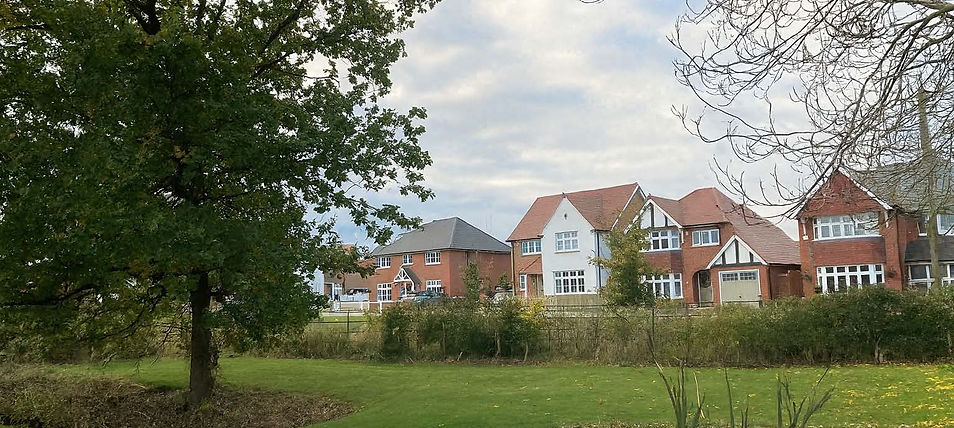
The site lies immediately adjacent to Redrow’s Westley Green development, one of the few sites released from the Green Belt at the last Local Plan review.
Its enclosed setting and close proximity to essential services make the site highly suitable for carefully considered, sustainable development.
The proposal aligns with the NPPF’s ‘Golden Rules’ for major development on released Green Belt land, providing at least 50% affordable housing, delivering essential infrastructure contributions, and creating new publicly accessible green spaces.
*As defined in the 2024/25 National Planning Policy Framework.

View looking south across the site from the north west corner
Our approach
Before creating the proposals for the site, the team carried out detailed surveys and technical studies to help shape the design. So far, these have included:

Transport Assessment
- evaluating traffic levels, access arrangements and sustainable transport options for future tenants of the site.

Ecology Impact Assessment
– to evaluate the impact of our proposals on the local environment.

Drainage Impact Assessment
– identifying any drainage issues that may arise from a development, and strategies to reduce flood risk.

Key Worker Affordability
Assessment – to assess the need for affordable housing solutions for key workers in Basildon.

Landscape and Visual Impact Assessment (LVIA)
- Evaluating the sensitivity of the character and appearance of the site and its setting.
Our proposals
Land north of Dry Street represents an excellent opportunity to create a smallscale, sustainable residential extension on a site that is well-connected and entirely contained by existing housing and mature woodland.
We have prepared a scheme that will deliver a new high-quality neighbourhood with accessible areas of open space, delivering a range of affordable housing types to meet local need, and to support the recruitment of NHS staff to Basildon University Hospital.

Up to 61 new homes aimed at key workers

Sustainable travel routes with direct connections to Basildon University Hospital and the surrounding areas

Open green spaces for recreation, fostering community and enhanced well-being.

Features like ponds, swales, and special paving will help soak up rainwater, reduce flooding, and keep water cleaner.

Streets linked to the newly proposed play spaces encouraging residents to play on their way through the site.

Biodiversity enhancements,
ensuring a net positive outcome for local wildlife habitats and green corridors.
The scheme will provide new high-quality affordable homes aimed at key workers
The need for key worker housing
Extract from the South Cambridgeshire District Council Local Plan (2018) – Policy on Rural Exception Sites

We are submitting an outline planning application for ‘up to 20 affordable homes’. As part of this, we have developed an illustrative masterplan that shows how the site would accommodate 20 homes above Masterplan as follows:

The scheme will deliver new affordable homes - Home Group’s Trinity Park
Basildon faces a growing need for housing, particularly for affordable options that meet the needs of key workers. Key workers are people in essential jobs, such as healthcare, that keep our communities running every day.
Given the site’s proximity to Basildon University Hospital, our proposals aim to address the housing challenges highlighted in early discussions with the Mid and South Essex NHS Foundation Trust, which are believed to be making it harder to recruit and retain staff.
Local housing challenges
A report by Turley reveals local housing challenges in Basildon:
Growing housing pressures with rising demand, affordability gaps, and staff turnover

Around 3,400 key workers are employed locally in the Health and Social Care sector

A salary of £51,968 is needed to buy a lower quartile-priced home (£285,000), above NHS salary bands 1–7 and out of reach for many dual-income households
Providing affordable
housing solutions
RO Land is proposing affordable housing focused on key workers, making use of the site’s proximity to Basildon University Hospital.
The scheme would support NHS staff recruitment and retention by providing high-quality homes near their workplace, while also helping to meet wider borough housing needs.
By delivering accessible, purpose-built homes, the development would support families, strengthen the workforce, and bring lasting social and economic benefits to Basildon.

Precedent imagery - Redrow's Westley Green
New affordable homes

The team will be seeking outline planning permission* for around 61 high-quality homes.

This will include affordable housing**, aimed at supporting local needs and key workers.
*Outline planning permission: A form of approval that agrees to the principle of development, with detailed designs to follow in a later “reserved matters” application.
**Affordable housing: Homes offered below market rates, through schemes such as social rent, affordable rent, or shared ownership, for households unable to afford full market prices.


Home Group owns and manages homes across Basildon and Essex and is working with RO Land on the Dry Street scheme.
The proposal will be submitted as a 50:50 split of market and affordable homes to meet planning requirements, but under Home Group’s delivery model it is intended to be delivered as entirely affordable, with priority for key workers.
About Home Group
Home Group is a major housing association, social enterprise, and charity operating across England and Scotland. It owns over 56,000 homes and supports more than 125,000 people, providing homes alongside health, social care, and community support since 1935.
What Home Group does
Home Group delivers affordable homes for rent and shared ownership, alongside specialist support for mental and physical health, learning disabilities, and over-55s
wellbeing. It focuses on sustainability, energy efficiency, and high-quality housing.
Proposed housing mix
The development will comprise up to 61 homes, with shared ownership, affordable rent, and social rented units delivered to address local needs.
It is expected that a Section 106 legal agreement will secure priority access for key workers – including local NHS staff – to the majority of the housing, ensuring that where possible these groups are given first opportunity.
Design principles
Our proposals include a sensitive design that responds to the local context:

Up to 61 new high-quality, affordable homes aimed at local key workers, with a mix of sizes to support a balanced community.

Retained and enhanced planting along Dry Street, combining existing vegetation with new landscaping to provide privacy, improve views, and strengthen biodiversity.
Pedestrian-friendly streets with low vehicle speeds, tree planting, and accessible recreation spaces.

Development kept away from the western and northern edges to protect Langdon Hills SSSI, while preserving mature trees along the eastern boundary.

Nature-led drainage features such as a planted swale and attenuation basin with boardwalk, designed to manage flooding, support wildlife, and create attractive public spaces.

A welcoming entrance and central
open space, with opportunities for
native planting and a pond to support
both biodiversity and drainage.

A context-sensitive layout, with homes set back from Dry Street to reflect the existing building line and maintain a green,
walkable character.
New walking routes linking Dry
Street Basildon University Hospital.

The proposed masterplan (left) which has been designed to respond to the local context
Landscaping and open spaces
Our proposals for Land north of Dry Street will see the site reimagined as a connected walkable neighbourhood where nature, movement and play are woven into everyday life.
Our landscaping strategy will create welcoming public spaces that are safe, inclusive and usable for everyone.
New pedestrian-friendly routes will make it easier to move through and around the neighbourhood, linking homes to the new public green spaces.
Other elements of the landscaping plan include:
Open spaces with native trees, shrubs, grassland, seating, and sensitive lighting
Welcoming design that complements surrounding land uses
Focus on biodiversity, seasonal interest, visual appeal, and climate resilience
Landscape-led approach creating a functional, enjoyable neighbourhood for all ages
Mix of gathering areas and quiet spots for rest and reflection
Transport and sustainable travel
We have developed our proposals for the site, recognising the existing pressures on the local road network.
The site’s southern boundary runs along Dry Street, linking it to Basildon University Hospital and the A176 to the east. The road has been widened and modernised south of the hospital and the recent Dry Street development.
As part of developing our proposals for the site, the project team has undertaken a Transport Assessment to analyse existing traffic flows in the surrounding area. This ensures that the proposed development will have minimal impact on local traffic levels.
Parking strategy
The development will provide car and cycle parking in accordance with local policy, and the Essex Design Guide Parking Guidance (2024). Street widths will accommodate refuse collection and emergency vehicles in accordance with Council standards.
Site access
Vehicular access to the site is proposed at the existing field gate, while pedestrian access will connect through new footpaths.
Promoting sustainable travel
Walking distance to Basildon University Hospital and key services promoting sustainable travel.
Safe, convenient routes to encorage walking, cycling and shorter local journeys.

Supports a healthier, more active lifestyle while reducing reliance on cars.

Upgrade to the Dry Street footpath to improve safety and attractiveness for residents and vistors.

Diagram showing how access to the existing Dry Street Road will be improved
Landscaping and open spaces
Our proposals for Land north of Dry Street will see the site reimagined as a connected walkable neighbourhood where nature, movement and play are woven into everyday life.
Our landscaping strategy will create welcoming public spaces that are safe, inclusive and usable for everyone.
New pedestrian-friendly routes will make it easier to move through and around the neighbourhood, linking homes to the new public green spaces.
Other elements of the landscaping plan include:
Open spaces with native trees, shrubs, grassland, seating, and sensitive lighting

Welcoming design that complements surrounding land uses
Mix of gathering areas and quiet spots for rest and reflection
Focus on biodiversity, seasonal interest, visual appeal, and climate resilience

Landscape-led approach creating a functional, enjoyable neighbourhood for all ages

1. Informal play space
2. Drainage basin
3. 4.1m drainage swale
4. Buffer to Dry Street
5. Circular walking route
6. Retention of existing trees
7. Proposes street trees
8. 15m buffer to Site of Special Scientific Interest (SSSI)
Enhancing biodiversity and sustainability

The adjacent Redrow scheme, illustrating green spaces alongside new homes
Ecological considerations
The site sits next to the Langdon Hills Site of Special Scientific Interest (SSSI), managed by Essex Wildlife Trust. Although the site itself has no formal wildlife designations, its proximity to this protected area makes ecology a key consideration.
The SSSI already faces pressure from heavy use of footpaths, anti-social behaviour, and encroachment into sensitive areas. We have engaged with the Essex Wildlife Trust on a potential range of measures to help reduce these impacts.
These include creating a 15-metre planted wildlife buffer, funding a dedicated ranger, improving paths and planting within the SSSI, and installing appropriate fencing to prevent informal access.

Enhancing biodiversity
The project team has undertaken an Ecology Impact Assessment, which has informed the site’s landscaping strategy. Despite its location, the site is dominated by a single grass species with low ecological value, and the absence of ponds or wildflower habitats further limits biodiversity.
We are proposing a landscaping strategy to enhance biodiversity, manage water sustainably, and create an attractive environment. Key features include:

A mix of trees and planters to boost biodiversity, attract insects and invertebrates, and provide foraging for birds.

Integration of Sustainable Drainage
Systems (SuDS) across the site.

Swales (shallow, planted channels) to
collect and filter rainwater.
Benefits including reduced flood risk, improved water quality, greener spaces, and enhanced wildlife habitats.
Precedent imagery of a swale, with proposed crossing
Public benefits
We believe that our proposals will deliver a comprehensive suite of benefits for the local community, creating a high-quality new neighbourhood that positively responds to its surroundings and provides much-needed homes to meet local need.
Key benefits include:

Delivery of 31 purpose-built affordable homes aimed at key workers, alongside a further 30 proposed affordable homes to contribute to wider borough needs.

New green, welcoming routes around the site.

Retention of mature boundary
planting, preserving the site’s natural character.

A new network of connected open spaces for access to nature, recreation and children’s play.

Enhancing the biodiversity of the area through new planting and landscaped areas around the site.

Protecting the amenity of the existing residents to the east and southwest of the site.

Safe pedestrian connections to
Basildon University Hospital.

A new street network that encourages walking, and healthy travel to reduce dependence on vehicles.
Share your views
Thank you for taking the time to view our proposals for the future of Land north of Dry Street.
If you have any further questions or feedback for the team, please get in touch via the details below:
Email: landatdrystreet@kandaconsulting.co.uk
Tel: 020 3900 3676
FAO: Land at Dry Street Consultation Team
Kanda Consulting
10 Chiswell Street
London, EC1Y 4UQ


Precedent images from the adjacent Redrow scheme, illustrating the frontage landscaping and open spaces